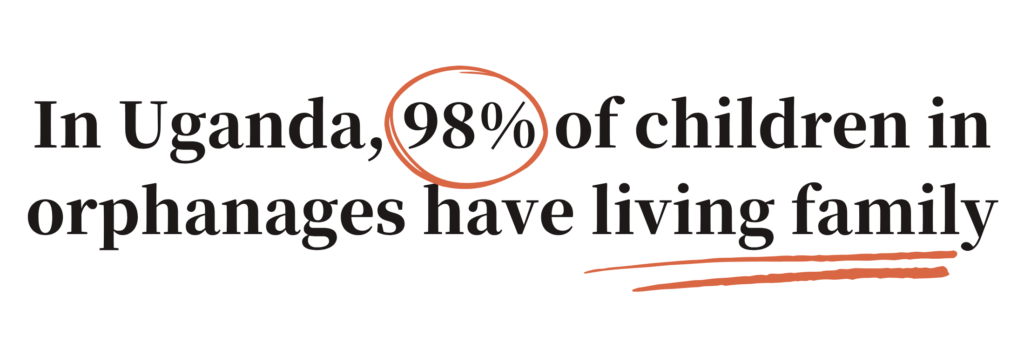
At sixteen years old, Mercy* had spent most of her life in a children’s home in Uganda. Her parents and brothers were alive, living in a village less than an hour away.
After the Lord’s Resistance Army attacked Mercy’s village as a young child, her family struggled financially and believed the best place for Mercy was in a children’s home where she could receive food, clothing, and an education.
Mercy wasn’t separated from her family because she had no one. Like millions of children around the world, she was separated not by the absence of family, but by the effects of poverty.
“Being apart is hard.
I miss my brothers.”
-Mercy, age 16
*Name changed for child protection
Most children are separated from their families not because they are orphaned, but because their families lack the support they need to stay together. Poverty, limited access to education and healthcare, and other challenges can push families toward residential care, even when they want to raise their own children.
WHAT RESEARCH TELLS US
Children belong in families.
Decades of research consistently point to one truth: children experience better developmental, emotional, and social outcomes when raised in families.
While orphanages may meet some physical needs, they cannot replace the love, identity, attachment, and lifelong relationships that families provide. When children can remain safely with—or return to—their families, they have the greatest opportunity to thrive.
of research shows the negative impact of residential care on children’s health, development, and life outcomes
A DIFFERENT WAY FORWARD
What if, instead of removing children from families because of poverty, we removed poverty from families?
For decades, orphanages and residential care have often been treated as the default response for vulnerable children. Today, research—and the experiences of families like Mercy’s—point to a better way.
Family-based care isn’t just better for children; it’s also a more effective use of resources. Supporting children in families typically costs 5-10 times less than caring for them in residential care, allowing limited resources to reach more children while strengthening the families and communities around them.
By strengthening families before separation happens, helping children return home whenever possible, and equipping organizations and communities to embrace family-based care, we’re reshaping the way the world cares for vulnerable children so more children can grow up where they belong: in families.
FROM WHY TO HOW
How We Respond
Creating lasting change takes more than one approach. Our work is built around three interconnected strategies that help more children grow up in families.